

Updated March 26, 2026
TL;DR: Apple Wallet is not a design tool. It is a policy engine.
- Apple Wallet is a policy engine disguised as UI
- Passes are credentials, not content — designed for validation, not expression
- The system enforces rules at runtime, not design time
- Designers control meaning, not layout
- Wallet behaves like safety UI — predictability beats novelty
- The constraints aren't fighting you. They're doing the design work.
Overview
Apple Wallet is not a design tool. It is a policy engine.
Every element you see — the fixed layout, the controlled typography, the strict field limits — exists to enforce rules, not enable expression. Apple Wallet's job is to prevent mistakes, ensure trust, and make credentials instantly recognizable.
Understanding this changes everything about how you design.
Why is Apple Wallet a policy engine disguised as UI
Most design systems exist to enable expression. Apple Wallet exists to enforce policy.
Every design decision in Wallet is shaped by questions like: Is this safe? Is this predictable? Is this trustworthy? Does this reduce mistakes?
The UI is not the product — it is the enforcement mechanism. This is why Wallet feels restrictive. And this is why it works.

Why does Apple design for failure prevention instead of flexibility
Apple Wallet is used in high-stakes moments: access granted or denied, tickets accepted or rejected, payments and entitlements verified, identity implied in public settings.
In these contexts, Apple optimizes for preventing misreads, preventing expired access, preventing ambiguity, and preventing hesitation.
Flexibility is intentionally sacrificed in favor of certainty. The design system reflects this priority everywhere.
The gate test
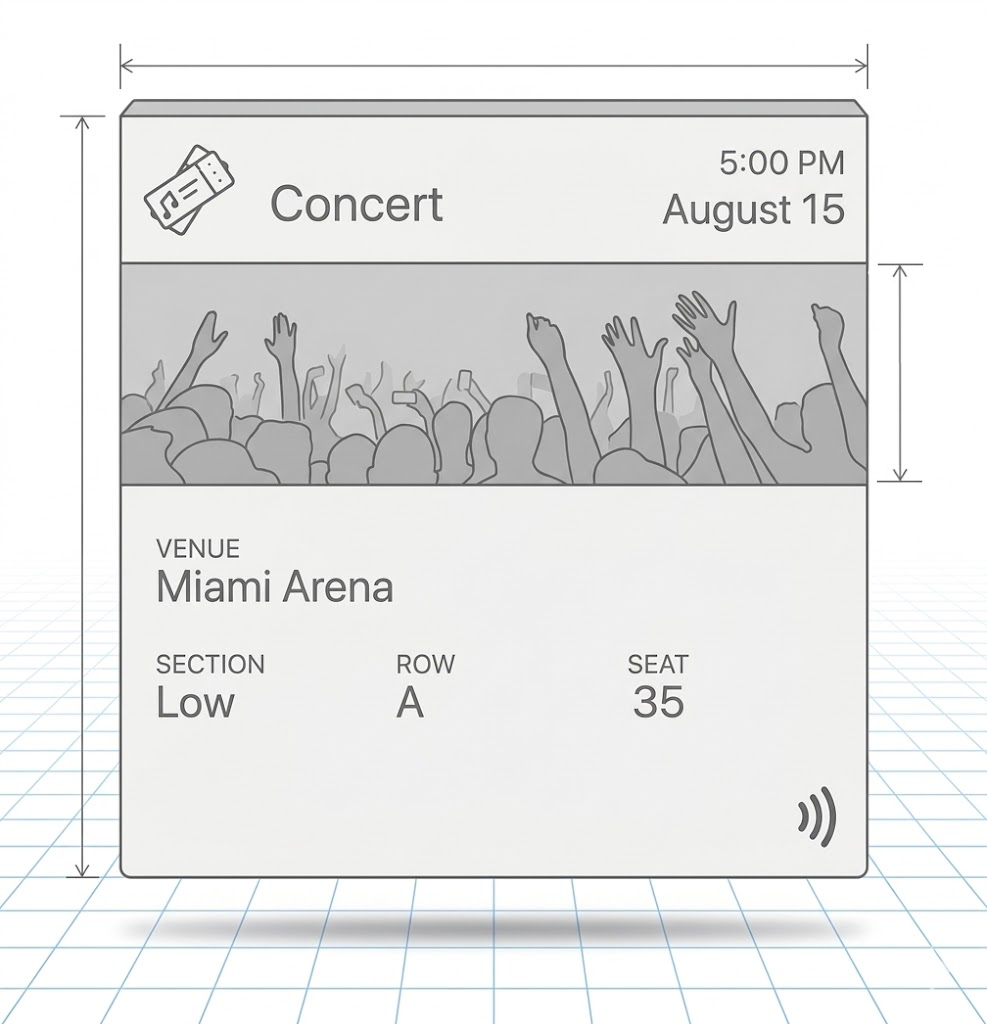
Imagine a concert venue. Thousands of people. One scanner. Two seconds per person.
In that moment, an Apple Wallet ticket must answer three questions without fail:
- Is this for tonight's show?
- Is this person's entry?
- Can I scan it now?
If the design requires interpretation — if the barcode is decorated, if the status is ambiguous, if the event name is truncated — the line stops.
Apple designs every constraint for this moment. Not for your mockup. For the gate.
Why are wallet passes treated as credentials instead of content
Apple Wallet does not treat passes as marketing surfaces, informational cards, or mini web pages. It treats them as credentials.
Credentials must be unambiguous, machine-readable, up-to-date, and instantly recognizable.
This single assumption explains many design outcomes:
- Native QR and NFC are first-class
- Decorative images are secondary
- Data matters more than layout
- Updates are privileged over interaction
Once you see passes as credentials, not content, the system makes sense.
Why is the design system enforced at runtime
In most design systems, designers apply rules at design time. In Apple Wallet, the OS enforces rules at runtime.
The system decides when a pass surfaces, how prominently it appears, whether an update matters, and which passes feel "active."
Designers do not control these outcomes. They provide signals. Apple Wallet is constantly evaluating relevance, trust, and state — long after a pass has been issued.
Why do designers control meaning instead of layout
Because Apple owns layout, typography, and interaction, designers are left with one primary responsibility: make meaning unmistakable.
This means choosing what is primary vs secondary, deciding what stays stable vs what changes, and designing for recognition, not reading.
The design system does not reward creativity. It rewards clarity.
Why does Apple Wallet behave more like safety UI than marketing UI
Apple Wallet behaves more like aviation interfaces, medical devices, and payment terminals than websites, apps, or brand experiences.
In safety-critical systems: predictability beats novelty, constraints beat flexibility, and consistency beats expression.
Apple Wallet follows this logic rigorously.
Why does understanding this philosophy matter
Many frustrations with Apple Wallet design come from a category error. People expect a canvas. Apple provides a contract.
Once you accept that contract, design decisions become simpler: work with the system, not against it; design for outcomes, not layouts; optimize for moments, not journeys.
What is the real design system
Apple Wallet's design system is not documented in components or tokens. It lives in its constraints, its surfacing logic, its intolerance for ambiguity, and its bias toward trust and predictability.
Understanding this is the difference between fighting the platform and designing passes that feel inevitable.
| Expectation | Reality |
|---|---|
| Passes are content | Passes are credentials |
| Designers control layout | Designers control meaning |
| Rules applied at design time | Rules enforced at runtime |
| System enables expression | System enforces policy |
| Flexibility is valued | Certainty is prioritized |
| Marketing UI patterns | Safety UI patterns |
The Shift
Stop seeing constraints as limitations. Start seeing them as the design.
Apple Wallet's constraints exist because passes are credentials, not content. Once you design with that truth, every decision becomes simpler: clarity over creativity, recognition over reading, trust over expression.
The system isn't fighting you. It's doing the design work.
More articles in Platform Guides
Every design difference between Apple and Google Wallet traces back to one choice:
Apple Wallet Layout AnatomyLayout in Apple Wallet is semantic, not spatial.
Designing Apple Wallet Passes: Text Alignment, Layout, and BehaviorYou cannot control how text looks in Apple Wallet. You can only control what it says.
Designing One Pass for Two PlatformsDesigning one pass for two platforms sounds efficient. It's actually one of the hardest problems ...
Google Wallet Design System ExplainedGoogle Wallet doesn't hold credentials. It connects systems.
Google Wallet Layout Behavior & Visual FlexibilityGoogle Wallet's flexibility is not an invitation to design freely. Flexibility demands defensive ...